
Checking Criminal History in Highland County
No single Highland County database contains every criminal record. Court files, sheriff reports, booking details, statewide criminal-history cycles, and custody data belong to different custodians. Start by naming the fact you need. A filed charge or final judgment calls for the Virginia court system. A recent arrest or incident report calls for the Highland County Sheriff or Virginia State Police. A statewide repository response comes from the Virginia Department of State Police Criminal Justice Information Services Division and its Central Criminal Records Exchange, known as CCRE.
Bring a full legal name, spelling variants, an approximate incident or hearing date, and any case or report number. Date of birth can help an official custodian distinguish similar names, though the public court display does not broadly show it. Follow the record rather than treating a name match as proof:
- Search Virginia Judiciary OCIS 2.0 for adult criminal and traffic matters, with Highland selected where the interface offers a locality filter.
- Repeat the search in the locality-based General District system, then check participating Circuit Court records for a felony that moved beyond the preliminary stage.
- Match court level, charge, offense date, case number, and disposition. Do not combine two people merely because their names match.
- Call the correct clerk for an older file, a missing result, or a plain or certified copy of the final order.
- Use the Sheriff, VSP CCRE, VADOC, or the registry only when that separate record type answers the question.
Online court data are leads. The clerk's file is the official court record, while a certified order carries the formal outcome.
Highland County Justice Record Hub
Highland County's record system is physically compact. The official county locations page places the Highland County Courthouse at 165 West Main Street in Monterey, where the Circuit Court clerk, General District Court, and Juvenile and Domestic Relations District Court operate. The Sheriff's Office is next door at 145 West Main Street. The Commonwealth's Attorney is listed at 165 Courthouse Lane. A visitor can move between nearby offices, but each custodian controls a different file and may not release another office's record.
The court counters keep posted public hours from 8:30 a.m. to 4:30 p.m. Circuit Court can be reached at 540-468-2447, and the combined General District and J&DR clerk at 540-468-2445. The Sheriff answers at 540-468-2210. Call before a winter trip or an archival request. Highland's mountain roads, periodic court dates, and older paper holdings make advance confirmation useful.
Highland Circuit Court
165 W. Main St., Monterey, VA 24465
540-468-2447
General District Court
165 W. Main St., Monterey, VA 24465
540-468-2445
The courthouse standing today replaced the original 1850 building lost in Monterey's 1947 fire. That history is a reason not to assume a modern web index reaches every old Highland County criminal record.
Virginia Official Background Checks
The Virginia Criminal History Record Check is the official public CCRE product. Virginia does not offer an anonymous, instant CCRE name portal. The general SP-167 route requires the subject's signed, notarized authorization, requester and subject identifiers, current payment, and submission under VSP instructions. The base name-search fee in the research is $15. A registry add-on, fingerprints, notarization, or a service provider can change the total, so read the current form before sending it.
A person reviewing their own record can ask VSP about a fingerprint-supported review and challenge. The Highland County Sheriff may be able to print an ink card, but no local service or fee is confirmed. Call first. Fieldprint serves certain Virginia programs, yet no Highland storefront was verified; the live scheduler determines the closest appointment. An FBI Identity History Summary is also a subject-only fingerprint product and carries an $18 FBI fee, apart from any fingerprint or channeler charge.
| Official route | Scope | Known base terms |
|---|---|---|
| Highland court index | Local filed cases and outcomes | Free search; clerk copy costs vary |
| VSP SP-167 | Virginia name-based repository response | $15; notarized subject signature |
| VSP fingerprint review | Own Virginia record and identity resolution | Current VSP and print fees apply |
| FBI Identity History Summary | Subject's FBI-maintained multistate history | $18 plus print or vendor cost |
Highland Court Search or VSP Check
A Highland County court search and a VSP check are not interchangeable. Court indexes show how a specific case moved, including a filed charge, hearings, plea, disposition, sentence, and costs when those fields are public. CCRE organizes identity-linked arrest cycles reported from across Virginia. It may show arrest and disposition data without supplying the deputy's narrative, pleadings, exhibits, or every event on the docket.
Use OCIS 2.0 when the goal is to understand a Highland court case. Choose CCRE when an official Virginia repository response is needed or when reviewing one's own state record for an unmatched outcome. If accuracy matters, compare both to the certified final court order. A dismissed charge can remain attached to an arrest cycle until the proper correction, expungement, or sealing process changes access.
The VSP Criminal Justice Information Services page shows the state infrastructure behind CCRE.
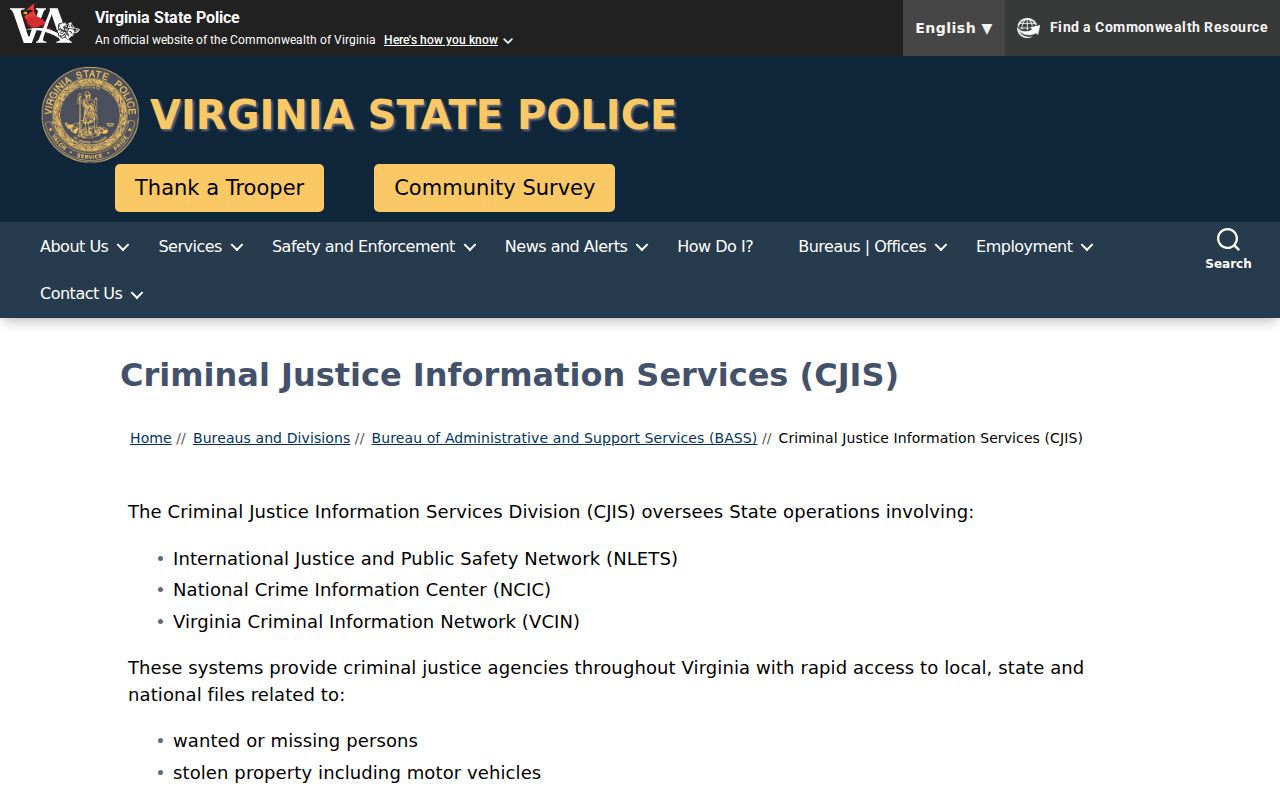
The agency page is a contact and program gateway, not a box where the public types a Highland County name for an instant result.
Criminal Record Types
A Highland County criminal record is not one document. The Sheriff or a VSP trooper creates an incident or arrest report. A receiving jail creates a booking entry when a person is held. A magistrate issues process and records a bail decision. The General District clerk keeps misdemeanor cases and felony preliminary-stage records, while the Circuit clerk keeps indictments, felony trials, district appeals, and final felony orders. VSP CCRE receives reported arrest cycles and dispositions.
Custody and public-safety systems answer still different questions:
- Incident or arrest report: the responding agency's account of an alleged event and enforcement action.
- Booking record: jail intake, charge, bond or hold, and release data from the receiving facility.
- Court case file: formal charges, hearings, motions, pleas, disposition, and sentence.
- CCRE history: identity-linked Virginia arrest cycles and reported outcomes under dissemination law.
- Warrant or registry record: a focused legal process or statutory public notice, not a full history.
Highland County does not run its own jail or publish a local roster. For a recent booking, call the Sheriff for the receiving facility. The VADOC Inmate and Supervisee Locator updates daily but does not replace that call or a local case search.
Three Highland Arrest Records Compared
One arrest can yield an agency report, a jail booking, and a court case that appear to disagree. The report describes why an officer acted and lists the alleged charge at that point. The booking desk records the charge delivered to the facility, intake identifiers, bond or hold, and release. Later, the prosecutor may amend, reduce, replace, or decline a count. The court then records the charge actually filed and its outcome.
| Record | Primary custodian | What it proves |
|---|---|---|
| Arrest report | Highland Sheriff or VSP | An agency recorded an arrest and alleged grounds |
| Booking entry | Receiving jail | A person entered custody under stated charges or holds |
| Court disposition | District or Circuit clerk | How the filed charge ended in that court |
None should be read beyond its role. Release from jail does not mean acquittal. An arrest does not establish guilt. A court dismissal does not by itself erase the agency arrest cycle. For full arrest routes, use the dedicated Highland County arrest lookup, then confirm the final case outcome with the clerk.
Inside a Highland County Criminal Record
Virginia CCRE data are organized around identity and arrest events. A response can contain a legal name, aliases, date of birth, sex, race, state identification number, FBI number if assigned, and fingerprint transaction identifiers. Each cycle can carry the arrest date, reporting agency, tracking number, charge and code, destination court, disposition, disposition date, and sentence. Corrections entries may add custody or supervision information.
| Name & identifiers | Legal and alternate names, birth data, and state or federal identification numbers where authorized. |
|---|---|
| Arrest data | Date, agency, tracking number, arrest charge, and the court receiving the matter. |
| Charges & statutes | Offense wording and cited Virginia Code sections, which may change as the case moves. |
| Disposition | Guilty, not guilty, dismissed, nolle prosequi, certified, deferred, or another reported result. |
| Sentence | Jail or prison term, suspended time, fine, costs, restitution, and supervision when reported. |
| Custody or supervision | VADOC status can help locate current incarceration, probation, or parole, but is not a full history. |
Audit a Highland County record cycle by cycle. Match the arrest date and agency to the right court case, then check that every count has a final result. Preserve both the VSP response and certified order when requesting a correction.
Certified Highland Court Cases
The word certified can mislead a reader. On a General District felony entry, it usually means the charge passed the preliminary stage and was sent toward the Circuit Court grand jury. It does not mean the General District Court entered a felony conviction. Search the Circuit Court record or call its clerk for the indictment and final order.
- Nolle prosequi
- The prosecutor chose not to continue that charge at that time. It is not a conviction.
- Dismissed
- The court ended the charge without a guilty finding in that case entry.
- Certified
- A felony matter moved from General District toward Circuit Court for further action.
- Capias
- Court process that compels a person's appearance. It is not a finding of guilt.
- Deferred
- A result whose effect depends on the statute, terms, and later final order.
Highland Circuit Court begins regular terms on the third Tuesday of March, June, September, and December. General District criminal and traffic dockets are posted for the first and third Wednesdays at 1:30 p.m. Those limited settings can explain a future date or pause without proving the outcome.
Public Access Laws in Virginia
The Virginia Freedom of Information Act gives a process for seeking county executive and law-enforcement records, but it does not open sealed court files, confidential juvenile material, or restricted CCRE information. Court access also rests on judicial rules and clerk duties. A Sheriff may release basic incident facts while withholding or redacting a detailed investigative narrative, victim identifiers, tactical facts, or material that could harm an active case.
Key Virginia laws:
Virginia Code §2.2-3700 et seq. sets the public-access policy and VFOIA request framework.
Virginia Code §2.2-3706.1 governs criminal incident information and law-enforcement records.
Virginia Code §19.2-389 et seq. controls dissemination of criminal-history record information.
Virginia Code §16.1-301 protects juvenile law-enforcement records.
Ask for a segregable, redacted copy and the exact exemption if part of a Highland County record is withheld. The open-records process cannot be used to bypass a sealing order.
Highland County FOIA Record Clock
Highland County's published VFOIA guidance uses a five-working-day response framework, beginning the day after receipt. The county may produce the records, withhold them under a stated exemption, release part with redactions, say that they do not exist or belong to another custodian, or invoke seven added working days. Very large requests may require an agreed schedule or court-approved time after the county tries to narrow timing with the requester.
The Sheriff has no published online form, separate records-division name, or flat local report price. Call 540-468-2210 and ask how to submit. County Administration can receive or route county-level requests at hcboard@highlandcova.org. A focused request should state the incident date and place, names involved, report number if known, exact record sought, preferred format, and whether inspection or copies are wanted.
| Channel | Highland route | Cost or timing |
|---|---|---|
| In person or phone | Sheriff, 145 W. Main St.; 540-468-2210 | Fee not posted; confirm ID and hours |
| County email | hcboard@highlandcova.org | Five-working-day response framework |
| Sheriff at 145 W. Main St. or County at P.O. Box 130 | Ask for an estimate and electronic delivery | |
| Court counter | Circuit or District clerk at 165 W. Main St. | Copy and certification charges apply |
The county may charge actual access, search, duplication, and supply cost. It may ask for advance payment when the estimate exceeds $200. No other Virginia county's report fee should be assumed here.
Sealed, Expunged, and Restricted Records
Juvenile files, sealed cases, victim data, financial identifiers, and sensitive investigative material are not ordinary public Highland County records. Redaction hides protected fields while leaving a releasable part. Sealing restricts the record itself. Expungement under Virginia Code §19.2-392.2 addresses qualifying police and court records, most often tied to a nonconviction result, identity misuse, an innocence pardon, or a vacated conviction.
Virginia's Chapter 23.2 sealing framework became operative July 1, 2026. It includes automatic and petition routes for specified records, with exclusions, waiting periods, prior-record rules, restitution terms, and petition limits. For a Highland matter, obtain each disposition, identify every charge from the arrest, and use the current Virginia Judiciary form. A traditional expungement petition is filed in the Circuit Court where the charge ended. The version effective on the research date states that qualifying petitioners are not charged court fees or costs.
The official Virginia criminal sealing forms collection should be checked against the live statute.
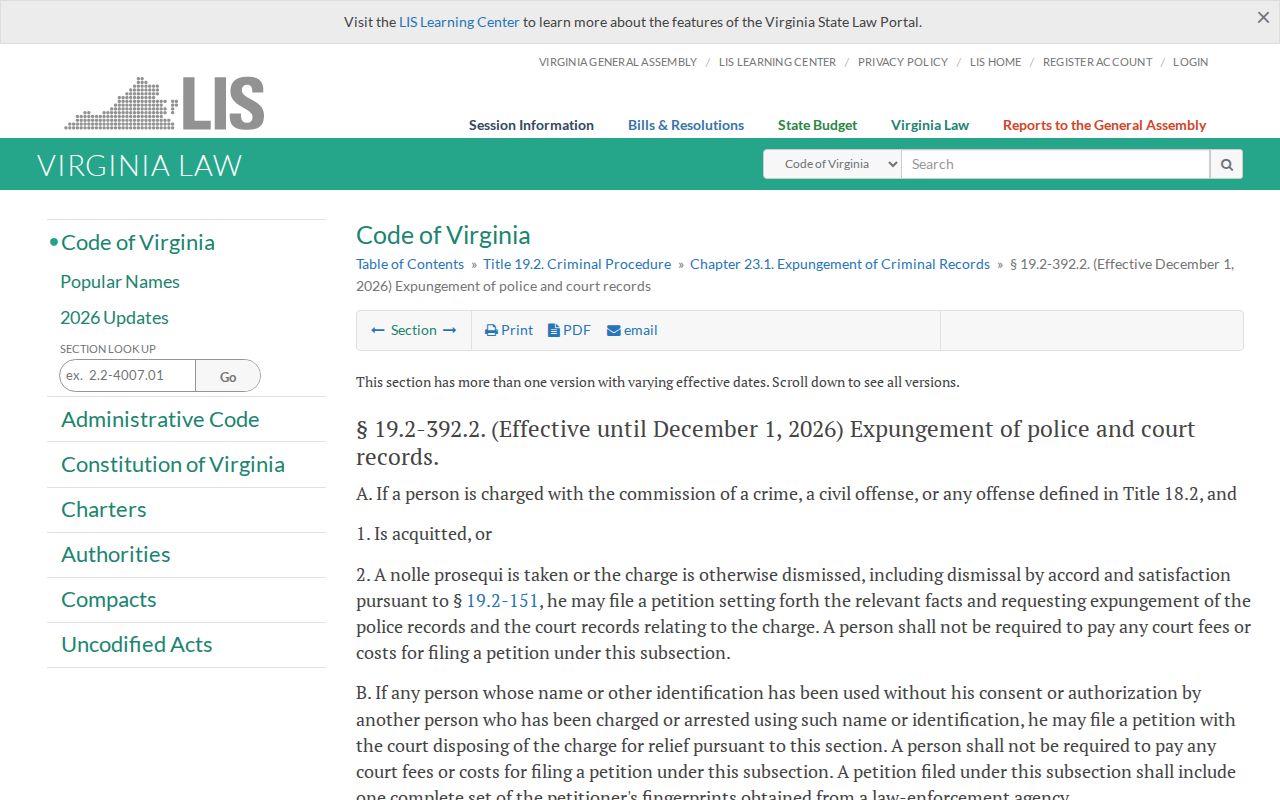
The statute image identifies the governing source; eligibility still depends on the case facts and current text, not a missing web result.
After an order, keep certified copies. The clerk sends notice to VSP and other custodians as required, yet systems may update at different times. Recheck the case index and one's own CCRE record, then use the certified order in any challenge.
Highland Warrant Records Without a List
No official Highland County active-warrant web list was found. The safe route is to call the Sheriff at 540-468-2210, check the relevant General District or Circuit case, and contact the issuing clerk. A lawyer can help arrange surrender and bond when arrest is possible. Search warrants, sealed process, and some unexecuted records are not public lookup material. Juvenile process is confidential.
An online docket may show a warrant, summons, capias, issue or service date, next hearing, and bond-related status. It may lag. Payment of an unrelated fine does not clear a criminal capias, and an old entry should not be treated as current instructions to appear at a place. Confirm status by phone before acting.
Highland County also has no public booking log. If a warrant has led to a recent arrest, ask the Sheriff which receiving jail holds the person. Use that facility's official contact, then check the court docket for the next hearing. VADOC becomes useful only when state custody or supervision applies.
Highland County Criminal Records by City
Monterey is Highland County's only incorporated municipality and the county seat. Its charter does not establish a police department or municipal court. A search for Monterey police or city court records therefore returns to county and state custodians: the Highland County Sheriff for local incident and arrest material, General District Court for misdemeanors and felony preliminary matters, and Circuit Court for felony trials and appeals. In the Virginia court search, choose Highland rather than Monterey.
Monterey Criminal Records
165 residents in the 2020 Census · county Sheriff and courts serve the town
McDowell, Blue Grass, Doe Hill, and other Highland communities are not incorporated towns or cities under the research criteria, so no substitute city pages were created for them.
Highland County Court Record Totals
The Virginia Judiciary's 2024 report counted 829 Highland General District Court dispositions across all categories. About 85.9 percent were traffic, 7.2 percent criminal, 6.5 percent civil, and 0.5 percent civil commitments. The listed case-management counts included 49 misdemeanor dispositions, three felony-category matters at the district stage, two capias matters, two show-cause matters, and one civil violation.
Those figures describe disposed court matters, not unique people and not a Highland County crime rate. One person may have several entries, and a traffic-heavy docket can reflect through routes and enforcement. Highland had 2,232 residents in the 2020 Census and an estimated 2,318 in 2025, but dividing docket rows by population would produce a false personal-risk claim.
The county's sparse mountain setting, quarterly Circuit terms, and set Wednesday district dockets help explain why a phone call can matter as much as a portal search. Verify live dates with the clerk, especially during severe weather.