
Sex Offender Checks in Highland County
The Virginia Sex Offender and Crimes Against Minors Registry is the controlling public source for Highland County. Virginia State Police maintains it and updates the public system each business day. It is a present-status tool. It does not replace a court docket, a certified judgment, or a statewide criminal-history record from the Central Criminal Records Exchange. Start with the registry when the question concerns a registrant's reported address, public status, qualifying offense, or failure-to-register notice.
The official Highland County site supplies no separate county offender map or published local registry list. That makes the state portal the first search channel. The Highland County Sheriff supplies the local follow-up channel for a suspected compliance issue, a stale-looking address, or registration instructions. Searchers near the West Virginia line may also need the federal national search because daily life in a border community does not stop at the state boundary.
Highland County Registry Check-Ins
Registrants in Highland County report through the Highland County Sheriff at 145 West Main Street in Monterey. The official county contact directory supplies the local office route, and the public telephone number is 540-468-2210. The office works within the statutory verification system run by Virginia State Police. No separate online appointment form, local registration calendar, or dedicated registry-unit page was found during the official channel sweep.
Call before appearing at the office. Staff can give current appointment and location instructions, while the state program controls the underlying duties and public record. The Sheriff's role is not a second public database. It is the local contact point where required reports and verification meet the statewide registry process.
Highland County Sheriff
Registration and local compliance contact
145 W. Main St.
Monterey, VA 24465
540-468-2210
The county's official office-location listing is useful for confirming the Monterey government complex before travel.
How to Search the Virginia Sex Offender and Crimes Against Minors Registry
Use a broad Highland County filter when spelling or the exact street address is uncertain. A name search works best with the last name and a first-name filter. Address and radius tools answer a different question: they show public results around a location entered by the user. Read the portal's terms and warnings before opening any profile.
- Open the official VSP registry and accept its conditions of use.
- Choose a name search, select Highland County, or enter an address with a radius.
- Review the result list and compare the public photo, aliases, age, and address rather than relying on a name alone.
- Open the profile, note its status and offense details, then contact VSP or the Sheriff if urgent information appears inconsistent.
The live search provides several routes rather than one required universal form:
| Field | Type | Required | Use |
|---|---|---|---|
| Last Name | Text | Search-path dependent | Starts a name search |
| First Name | Text | Optional | Narrows name results |
| County | Dropdown | Optional | Select Highland |
| City or ZIP | Text or dropdown | Optional | Uses locality or postal area |
| Address and Radius | Text and dropdown | For radius path | Finds results around a location |
| Map or List | Controls | Optional | Changes result display |
Highland County Cross-Border Registry Searches
A Highland County search is confined to the Virginia system. For an address close to West Virginia, the Dru Sjodin National Sex Offender Public Website adds a cross-state layer by querying participating jurisdictions. It is useful for community awareness across state lines, but it does not take control of the source profiles. Each participating jurisdiction remains responsible for its own entry and update schedule.
The official NSOPW interface shown below is the assigned cross-state source for Highland County registry research.
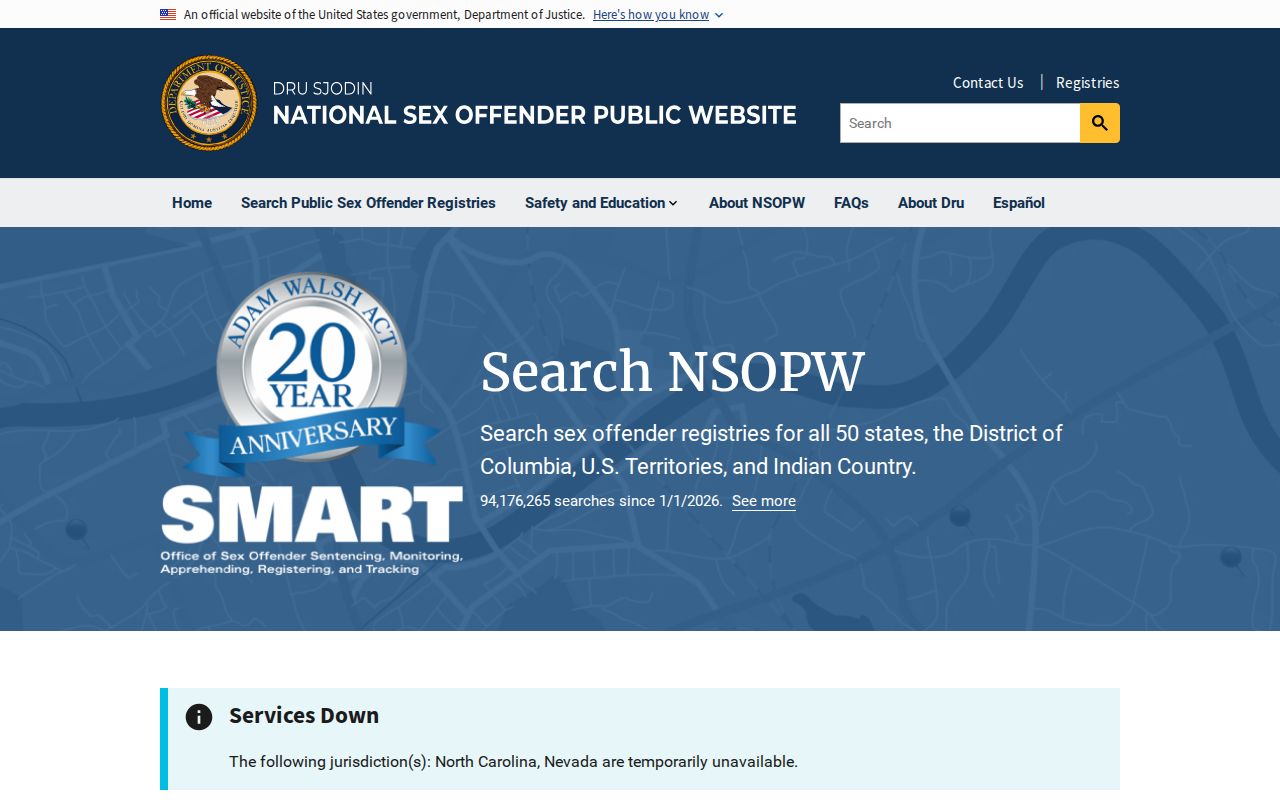
The national view broadens geography; the Virginia profile remains the right place to read Virginia status details and warnings.
Inside a Registry Profile
A public registry profile supplies identification and current reporting details authorized for release. VSP's public fields are designed to distinguish people and support safety awareness. The live interface did not reliably load during the research review, so unverified fields such as vehicle details, tattoos, height, weight, hair color, and eye color are not promised here.
| Legal Name and Aliases | The reported legal name and other public names tied to the entry. |
|---|---|
| Photograph and Age | A public image and age information used to help distinguish a person. |
| Current Address | The address currently published under Virginia's registry rules. |
| Work and School | Current work address and higher-education institution attended when publicly reportable. |
| Conviction Information | Conviction date, locality, and a brief description of the qualifying offense. |
| Registration Status | Public-safety status such as wanted for failure to register, when applicable. |
VSP warns that information can change. Treat a profile as a current state record, not a complete life history or an individualized prediction of future conduct.
Highland County Registry Versus Criminal History
A registry match answers whether the state currently publishes a person as registered under the Sex Offender and Crimes Against Minors Registry Act. It does not list every charge, dismissal, sentence, or later case. A Highland County court search can show public docket events, while a person's own VSP criminal-history review can show repository cycles subject to Virginia dissemination rules. Those products serve different purposes.
This distinction prevents a common error. Absence from the registry does not prove that someone has no criminal record. A registry entry also should not be stretched into claims about events that the profile does not report. Verify the qualifying conviction through the originating court when an exact order matters.
For federal court context, the manifest assigns the official PACER gateway image below.
PACER concerns federal dockets, not Highland County registry status, which shows why record type and custodian must be identified first.
Virginia Registration Levels and Requirements
Virginia tiers are offense categories set by statute. They are not personal risk scores, and VSP states that it has not assessed each registrant's chance of reoffending. Tier I and Tier II registrants generally verify once a year. Tier III and designated murder registrants verify about every three months. A failure-to-register conviction can make Tier I or Tier II verification more frequent.
| Category | Duration or Removal Route | Verification |
|---|---|---|
| Tier I | A qualifying single offense may support a removal petition after 15 years | Generally annual |
| Tier II | A qualifying single offense may support a removal petition after 25 years | Generally annual |
| Tier III or designated murder | Generally lifetime with no ordinary removal petition | Four times yearly, about every three months |
| Juvenile or adjudication situations | Specialized rules apply | Do not infer duties from the adult chart |
The 15-year and 25-year points do not create automatic removal. A qualifying petition remains subject to treatment, restitution, later-conviction, and public-safety conditions under Virginia law.
Highland County Registry Residency Rules
No blanket Highland County residency radius was found in the official county and state research. Virginia does impose offense-specific and status-specific rules involving schools, child-care settings, access, and residence. Those laws cannot be reduced to one distance that applies to every registrant in every circumstance.
Use the actual registry profile and current statute. Do not draw a private boundary on a map or assume that an address inside a chosen radius is unlawful. VSP or the Highland County Sheriff can receive a suspected compliance report, while a court determines whether conduct violates the law.
Stale Highland County Registry Addresses
A displayed address that seems old is a reason to verify, not to investigate in person. Note the profile, the address, and the apparent inconsistency. Then contact the Highland County Sheriff or Virginia State Police. Use 911 only when there is an immediate safety emergency. Do not confront the person or visit the location to test the data.
The state refreshes the public system each business day, yet a move, pending verification, data correction, or mistaken assumption about the address may explain what a reader sees. Reporting the concern through official channels lets trained staff compare nonpublic compliance records without exposing neighbors to risk.
Note: A public registry update schedule does not guarantee that every real-world change appears at the moment it occurs.
Community Notification and Lawful Use
Virginia publishes registry data for community awareness and safety planning under the Sex Offender and Crimes Against Minors Registry Act. Readers may use the information to understand nearby public entries, discuss age-appropriate safety steps with family, and report a suspected violation. They should account for the state's accuracy warning and verify urgent questions with the agency that maintains the record.
Use restraint. A registry result never grants power to threaten, shame, follow, or intimidate a registrant or members of that person's household.
Misuse is unlawful: Virginia Code §9.1-913 governs public dissemination. The registry's posted warnings prohibit using the information to threaten, intimidate, or harass. Misuse can bring criminal or civil consequences. Never confront a registrant; report a suspected violation to the Highland County Sheriff or VSP.